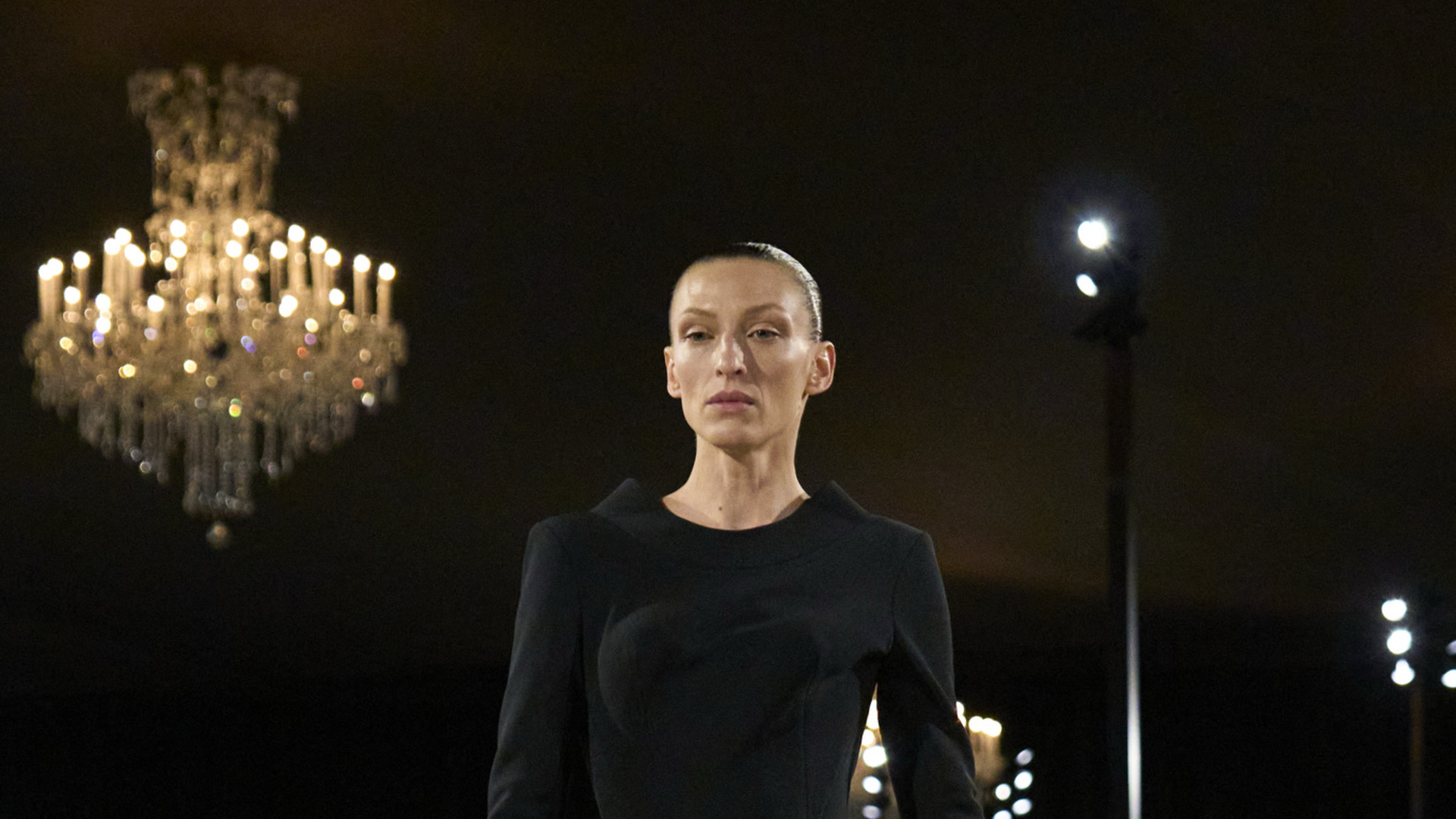
Daniel Roseberry deleted his social apps, drove the U.S. East Coast, and came back to Paris training for the New York Marathon — then put that flow state on the Schiaparelli runway. WWD’s Joelle Diderich, publishing her Schiaparelli Spring 2027 review on 2 October 2026 under a “Go With the Flow” frame, reports a collection that went back to basics with mix-and-match separates in a monochrome palette. Who What Wear’s Allyson Payer, writing the same Paris morning, calls the shift wearability without abandoning Elsa’s drama. For Cover Issue’s runway desk on Saturday 3 October IST, Schiaparelli SS27 is the clearest “going clear” story of the new Paris day: monochrome separates you can actually recombine, staged like a Champagne speakeasy under the Carrousel du Louvre.
The Carrousel speakeasy and the client who buys what she sees
According to Diderich, Roseberry transformed the basement of the Carrousel du Louvre into a cozy speakeasy where guests including Tate McRae, Marisa Berenson, and Thai stars Keng Harit and Namping Napatsakorn — twinning in black and white — sat around café tables sipping Champagne. House muse Maggie Maurer opened the show in a backward tuxedo dress subtly reproportioned with hourglass boning. A bodysuit was carved into a dramatically plunging neckline, while sculptural frills framed the open back of a little black dress. Schiaparelli is sold in just a handful of boutiques worldwide, Diderich notes, so it has a direct line to its clientele. “She’s the concept. It’s all about her,” Roseberry said backstage. “What we show is what we produce, is what she buys, is what she wears. There’s no commercial collection.” Cover Issue treats that as a published house rule, not as invented scarcity marketing.
Ease beside precision — and the eveningwear trends Who What Wear flagged
In contrast to those precision silhouettes, Diderich writes, there was an ease to wide tuxedo shirts with molded satin bibs, and a stretch top draped in laminated jersey that could be dressed up with a skirt or down with black pants depending on the wearer’s mood. Best known for gilded occasion wear, the house padded out its offer with a chic warm-weather wardrobe that this season riffed on broderie anglaise and spiral knits. Payer’s Who What Wear read lists the eveningwear signals buzzing after the show: the return of low necklines in asymmetrical, gathered, and off-shoulder cuts; sculptural ruffles; embroidered jackets that honor archive codes; shorts from micro to Bermuda length styled as eventwear, not casual; and jewelry-like gold hardware, including ring closures and the house’s signature gilded nipple covers on frilly suits worn bare-chested. Cover Issue attributes those trend labels to Who What Wear’s runway gallery notes.
Archival vegetables, Mariah on the speakers, and renewing the vows
The final jackets, Diderich reports, honored founder Elsa Schiaparelli with archival embroideries, including the multicolored vegetable motifs from her 1941 collection. After seven years at the house, Roseberry said he felt the proverbial itch, but came back from his social media blackout with newfound clarity — and a positive mood that felt contagious. His soundtrack, with Mariah Carey, Missy Elliott, and Faith Evans, put a bounce in models’ steps. “It’s been really nice to let it breathe a little bit,” he told Diderich. “There’s a moment too of renewing the vows and recommitting, and also to reimagining what the next chapter is going to be like.” Payer quotes show notes that close the commercial gap: what is shown is produced, purchased, and worn — the vision complete when it is on your back. Cover Issue does not invent a sales forecast beyond that published clarity.
How to wear Schiaparelli SS27 monochrome without a Carrousel seat
Readers searching Schiaparelli SS27 can pull a practical brief. First, build a black-and-white mix-and-match kit: one plunging or sculptural top, one wide tuxedo shirt, one sharp skirt or satin pant — recombine by mood. Second, try a single sculptural ruffle or open-back frill as the drama piece so the rest of the look stays tailored. Third, if you want the house gold, limit hardware to one closure or jewelry-like accent; skip full costume nipple-cover cosplay unless that is explicitly your night. Fourth, treat an embroidered or archival-motif jacket as the finale layer over quiet separates. Soft slicked hair and a monochrome café-table attitude beat full Surrealist props for weekday translation. Credit Diderich for venue and Roseberry quotes; credit Payer for the eveningwear trend checklist.
Where this sits on Cover Issue’s Paris map
Batch 26 already covered Balenciaga stitch fixation and Chloé broderie anglaise; Batch 25 logged Courrèges and Tom Ford. Schiaparelli SS27 is a different chapter: Roseberry’s monochrome flow state and no-commercial-collection honesty, not Piccioli construction or Kamali lace. Cross-link prior Schiaparelli surrealist files when packaging PFW clusters, but keep Going Clear / mix-and-match distinct. Do not invent front-row dating gossip around named guests — list them only as WWD-reported attendees.
Search language for the desk
Primary: Schiaparelli SS27. Secondary: Daniel Roseberry Going Clear, Schiaparelli Carrousel du Louvre, mix-and-match monochrome, Schiaparelli plunging neckline, Elsa archival embroideries 1941. The cover photograph is a real Courtesy Schiaparelli / WWD runway still of a black sculptural midi against the café-table speakeasy — full-bleed 16:9, no baked-in headline — because a monochrome reboot demands a photographic black dress, never a Surrealist clipart eye.
A note on packaging
When packaging for Cover Issue RUNWAY on 3 October IST, lead with Diderich’s flow-state thesis and Roseberry’s “no commercial collection” quote, then secondary-link Payer’s low-neckline and embroidered-jacket checklist. Stay inside fashion news. Readers comparing this file to Batch 26’s Balenciaga hero will feel a clear new angle: yesterday’s stitch construction, today’s monochrome wardrobe clarity.